
Cost Breakdown For Full Service Whole Home Remodel
A cost breakdown for a full service whole home remodel helps owners see where money is allocated. Riley Riley Construction provides sample breakdowns for labor materials permits and contingencies. Call 17207828897 to receive a tailored estimate that reflects your priorities. This content aims to increase budget transparency and planning accuracy.
Embarking on a full service whole home remodel is a complex financial decision. A clear cost breakdown for full service whole home remodel projects helps homeowners understand where funds are being invested, which trade-offs are being made, and how decisions in one area affect another. Riley Riley Construction approaches budgeting with transparency and a focus on outcomes: durability, aesthetics, and long-term value. If you want an estimate that matches your goals, reach out to 17207828897 to discuss a tailored plan.
Core cost categories and what each covers
Most whole home remodel budgets divide into a consistent set of categories: labor, materials, permits and fees, design and engineering, project management, and contingencies. Grouping expenses this way makes it easier to compare bids, decide where to upgrade or save, and forecast the final project cost. Below are descriptions of each category and typical items included so you can make more informed trade-offs with your contractor.
Labor refers to the onsite work performed by carpenters, electricians, plumbers, HVAC technicians, finish crews, and general laborers. Materials include everything from structural lumber and drywall to cabinets, tile, countertops, paint, and appliances. Soft costs such as permits, engineering, and design fees are essential but often underestimated. Contingencies account for unknowns and changes that arise once walls are opened or systems are evaluated more carefully.
Typical budget categories (brief)
- Labor: onsite trades, supervision, and subcontractor scheduling.
- Materials: structural, finish, appliances, fixtures, and hardware.
- Permits and fees: municipal permits, inspections, and plan reviews.
- Design and engineering: architect or designer fees, structural plans, and MEP drawings.
- Project management: scheduling, coordination, and clean-up.
- Contingency: unexpected repairs, code upgrades, and owner changes.
Sample allocation percentages and example budget
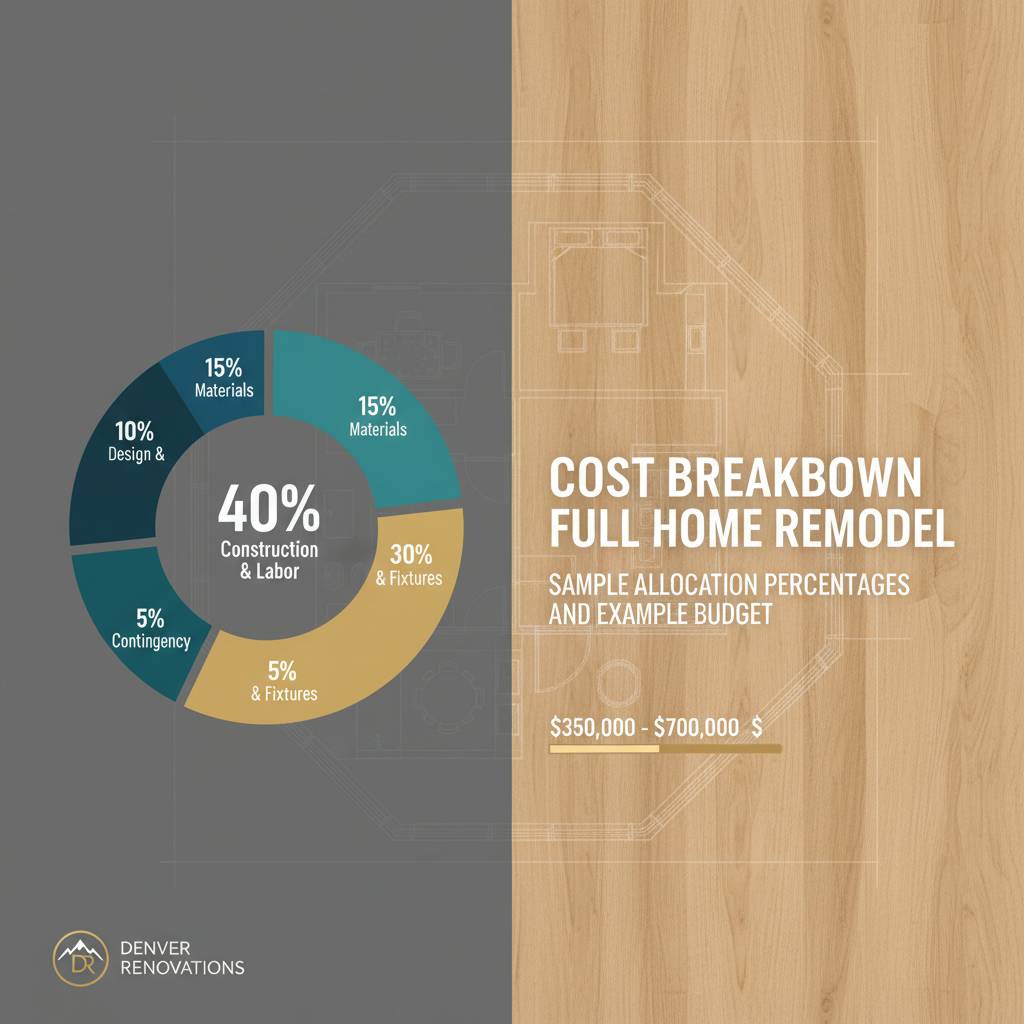 While every project is unique, many whole home remodels follow a similar percentage split of the total budget. The example below shows a common allocation for a comprehensive remodel and gives homeowners a starting point for comparison. Percentages can change by region, home condition, and finish level, so use these as a guideline rather than a rule.
| Category | Percent of Budget | Example (for $200,000 total) |
|---|---|---|
| Labor | 30%-40% | $60,000-$80,000 |
| Materials and finishes | 30%-40% | $60,000-$80,000 |
| Design, engineering, permits | 5%-10% | $10,000-$20,000 |
| Project management and overhead | 5%-10% | $10,000-$20,000 |
| Contingency | 5%-15% | $10,000-$30,000 |
In this $200,000 example, labor and materials are the two largest line items and together often consume 60%-80% of the total. Adjust priorities-such as selecting higher-end finishes or investing in energy-efficient systems-and those percentages will shift accordingly. When you ask Riley Riley Construction for a tailored estimate, we map your priorities onto these categories and explain the trade-offs clearly.
Understanding labor and material costs in detail
Labor costs vary with regional wage rates, the complexity of the work, and the level of finish required. For example, basic carpentry and drywall work typically charges per square foot or per day, while specialized trades such as custom millwork, stone fabrication, or historic restoration often command higher hourly rates. In many areas, trade rates are in the range of $75-$200 per hour depending on specialization, travel, and licensing. Labor also includes the general contractor's supervision, which ensures coordination among trades and protects schedule integrity.
Material categories and cost drivers
Materials range from commodity items like drywall and framing lumber to premium products like custom cabinetry, natural stone countertops, and designer fixtures. The cost variation is driven by brand, performance, and availability. For instance, midrange kitchen cabinets might cost $8,000-$25,000, while high-end custom cabinetry can exceed $50,000. Appliances, tile, and lighting are also significant contributors. Choosing durable, proven products can reduce long-term maintenance costs even if upfront expenses are higher.
How selections influence labor
Certain material choices increase labor time and cost: large-format tile requires careful substrate preparation and more precise installation; custom millwork takes longer to fit and finish; structural changes requiring new framing or beam installation add both material and labor. When evaluating quotes, review not only material allowances but also the estimated labor hours tied to those choices so you understand the full impact on the budget.
Soft costs: permits, design, engineering, and compliance
Soft costs are frequently overlooked by homeowners but they can be substantial. Permit fees vary widely: municipal building permits could be as low as $500 for minor work or exceed $5,000 for major structural projects, depending on valuation and locality. Design and engineering fees typically range from a percentage of construction costs to fixed fees; expect roughly 3%-10% for architecture and engineering combined on a whole home remodel. These services ensure design intent, structural safety, and code compliance-critical for resale value and insurance.
More complex projects-adding new systems, altering load-bearing walls, or changing egress configurations-usually require structural calculations and detailed plans. These additional documents add both time and cost but reduce risk. Riley Riley Construction helps clients understand what permits and design work are required by local authorities and builds those line items into the project budget rather than treating them as surprises later on.
Contingency planning and dealing with unknowns
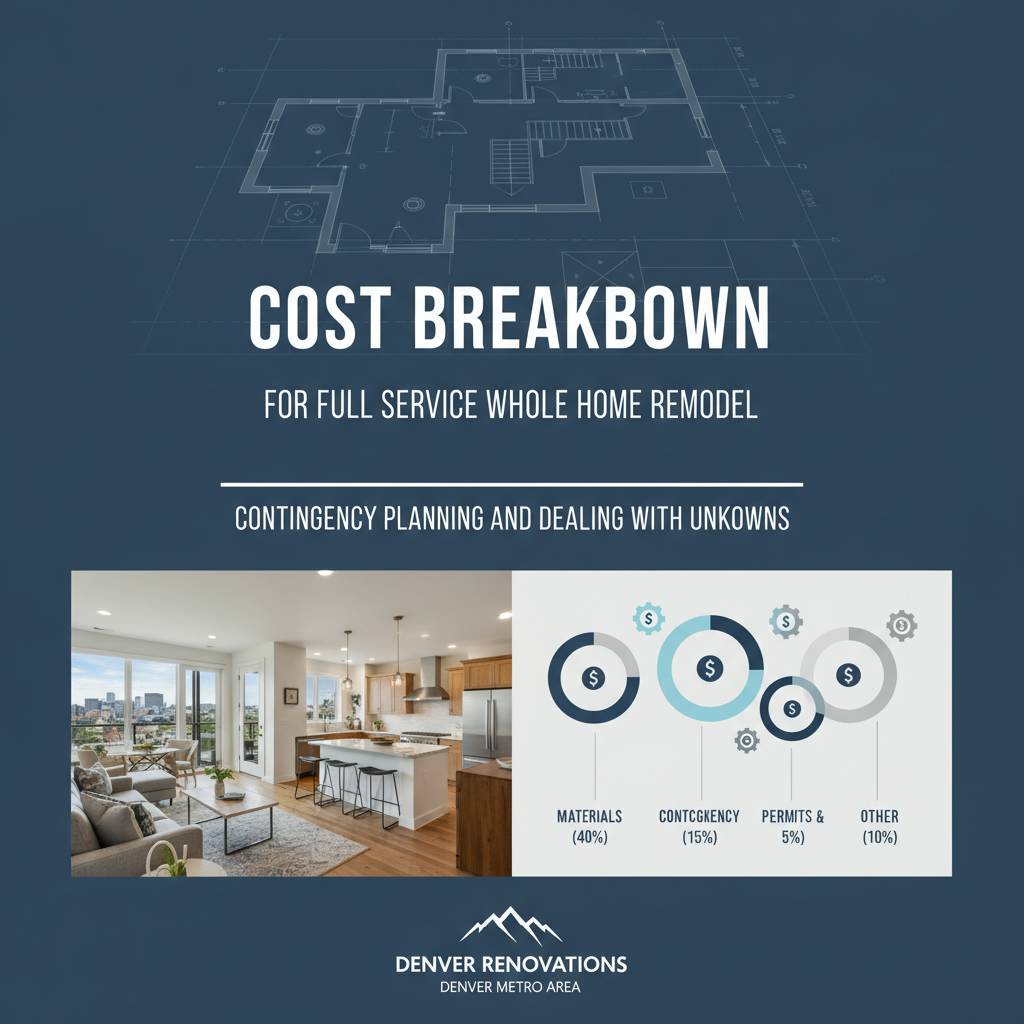 Every whole home remodel should include a contingency allowance. Standard practice is to allocate 5%-15% of the project budget to cover unforeseen issues: hidden water damage, termite or rot remediation, unanticipated code upgrades, or changes in owner scope. For older homes, or projects that involve opening walls and floors, a higher contingency toward the 10%-15% range is prudent. Contingency funds are not a substitute for careful inspection, but they provide a safety net that keeps the project moving when surprises arise.
When change orders occur, clear documentation and a scope-change process help control costs. Use allowances in your contract to define expected ranges for cabinetry, countertops, and appliances. An allowance lets the contractor assume a midrange product and then you choose a product with either an upcharge or credit. clients often find that well-defined allowances and a visible contingency line reduce stress and facilitate smarter decisions as the project progresses.
Prioritizing upgrades and cost-saving strategies
With a meaningful cost breakdown for full service whole home remodel projects, homeowners can identify high-impact upgrades and lower-priority cosmetic changes. Structural and systems work-roofing, foundation, electrical, plumbing, and HVAC-should take precedence because they affect safety and long-term performance. After systems are secure, allocate funds to functional spaces like kitchens and bathrooms where value is most often realized on resale.
- Invest in long-term systems (HVAC, electrical, insulation) before luxury finishes.
- Choose durable midrange finishes that perform well and look contemporary.
- Limit custom work to a few focal pieces (e.g., custom range hood or built-ins) rather than customizing throughout.
- Leverage staged upgrades-complete priority work now and plan cosmetic updates for later.
Value-engineering is not about cutting quality; it's about choosing intelligent substitutes that produce similar aesthetic and functional outcomes at lower cost. Riley Riley Construction can walk you through equivalent material options and their lifecycle costs so you know which savings are short-term and which pay off over time.
Case study: a representative full service remodel
Consider a representative project: a 2,500 square foot home undergoing a whole home remodel with a $300,000 budget. A typical allocation might look like this: $100,000 labor, $110,000 materials and finishes, $15,000 design and permits, $15,000 project management and overhead, and $60,000 contingency used as needed. On this scale, homeowners can upgrade kitchens and bathrooms to high-mid finishes, replace major systems, and add meaningful aesthetic and functional improvements while maintaining a robust reserve for surprises.
In one recent project, owners prioritized an open kitchen, upgraded HVAC, and new windows for energy savings. They used a contingency to address unforeseen structural shimming under the second-floor framing discovered during demolition. Because the contingency was planned, the schedule required only minimal adjustment and the overall project met the revised budget without compromising on the owners' priority finishes.
Managing timeline and payments to control cash flow
Cash flow planning is a critical part of the cost breakdown. Payment schedules commonly include a deposit, progress draws linked to milestones (for example, framing complete, rough mechanicals complete, and finish install), and a final payment at substantial completion. Milestone-based payments align incentives and reduce risk for both homeowners and contractors. Avoid large upfront payments beyond a customary deposit and insist on documented acceptance of each milestone before releasing the next draw.

Delays often increase indirect costs like temporary housing, storage, or additional site security. Include a realistic time contingency in your planning and discuss schedule risk with your contractor. Well-managed projects maintain a transparent schedule and communicate schedule impacts immediately so owners can decide whether to accelerate options (at cost) or accept schedule extensions.
Frequently asked questions
- How much should I budget per square foot for a whole home remodel? Costs vary widely by region and finish level, but a broad range for comprehensive remodels is $80-$250 per square foot. Tailoring budgets to your goals yields more accurate planning-contact Riley Riley Construction for a custom estimate.
- What is a realistic contingency percentage? For most remodels 5%-15% is appropriate. Older homes or projects uncovering structural issues should target the higher end of that range.
- Can I lock material costs? Some vendors offer price guarantees for a period, but longer lead times or custom items may require deposits. Allowances in the contract help manage this while keeping options flexible.
- What is included in project management fees? Project management covers scheduling, coordination of trades, quality inspections, communication, and cleanup. It ensures the project runs smoothly and on time.
Next steps and how to get a tailored estimate
If clarity around the cost breakdown for full service whole home remodel is your goal, start with a focused scope and an open discussion about priorities. Share photos, a wish list, and any known issues with your home. Riley Riley Construction will prepare a transparent estimate that maps your priorities against realistic allocations for labor, materials, permits, and contingency so you can make decisions with confidence.
To receive a personalized consultation and a detailed budget guide for your home, contact Riley Riley Construction today. Call 17207828897 or request a quote online. We'll walk you through examples, comparable projects, and specific choices that match your timeline and desired outcome.
We look forward to helping you plan a successful remodel that reflects your priorities and respects your budget. Reach out to Riley Riley Construction at 17207828897 to get started.